The build story
The curriculum that marks itself.
Kākā Math is a maths tutor for New Zealand kids, fronted by a kākā with opinions. Under the feathers it is the most ambitious AI system in the workshop: lessons from Year 1 to Year 13 mapped to the NZ curriculum and the NCEA numeracy standards, with the secondary-school configs tracing each NCEA content area down to specific lessons and back into earlier years for kids with gaps.
- lessons
- 1,596 lessons
- questions
- 36,840 questions
- single-job agents
- 23 single-job agents
- review batches
- 900+ review batches
The word problems are peopled by a recurring Kiwi cast, because a NZ kid should not be calculating in dollars that look suspiciously American.
-
 Coach Tama
-
 Nan Helen
-
 Uncle Sione
-
 Farmer John
Twenty-three small agents, not one big one
Content generation is split into single-purpose agents, twenty-three of them. One outlines a syllabus, one plans a lesson, one writes questions, one writes hints, one prompts illustrations, one draws SVG diagrams. Behind them sit about four thousand lines of prompts, run through queued jobs. Two providers, split by the job: Claude writes the curriculum, Gemini runs the tutor, because the tutor has to answer while a kid is waiting. Anything that needs no model at all, like checking a numeric answer, is done deterministically.
Hints, never answers
The tutor’s rule is Socratic: it can nudge, it cannot tell. Hint one asks the kid to estimate. Hint two names the method. There is no hint three, and the answer is never in the hint text. Try it on a real Year 6 question, with the real hints.
Year 6 · division with 5-digit numbers · question 8 of 11
Calculate 24,568 ÷ 8. Type the quotient only.
That is all the help there is. The answer is never in the hints.
When a kid photographs handwritten working instead, a fast vision model reads the page, finds the questions on it and marks them one by one, then tutors the wrong ones the same way: with a nudge, never the answer.
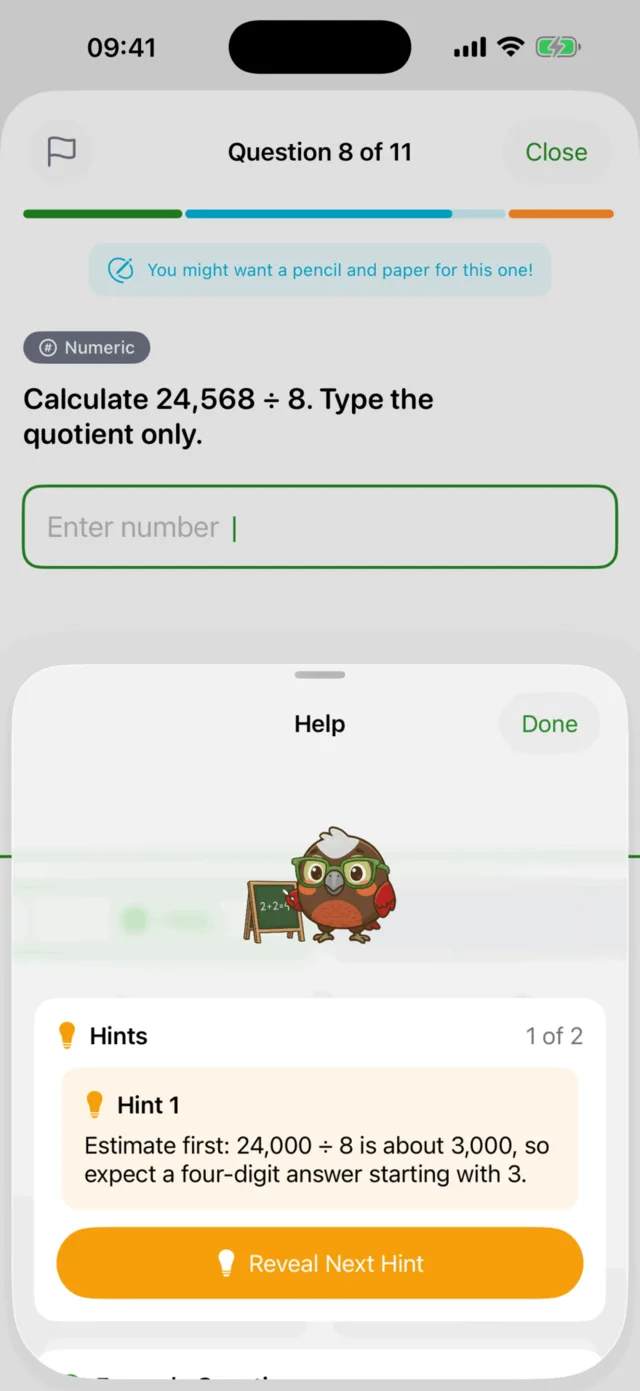
Hint one, in the app. The kākā with the chalkboard is the tutor.
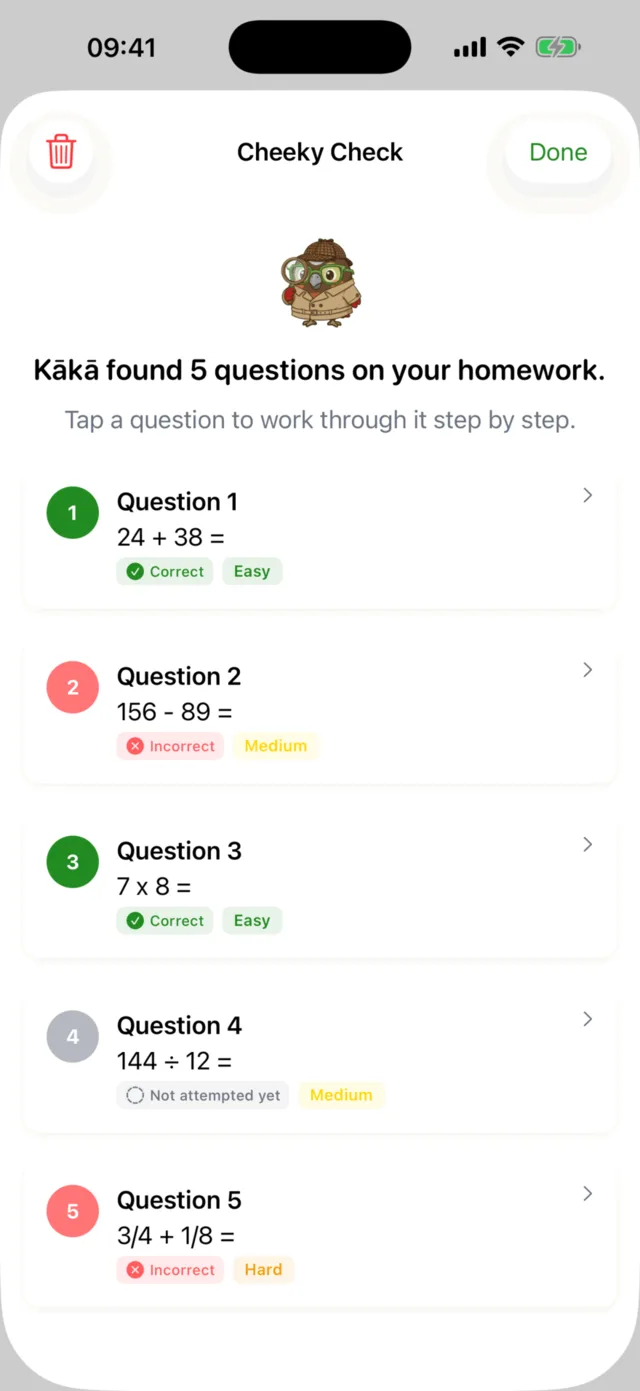
Cheeky Check: a photo of homework, read and marked question by question.
AI writes it. A panel of AI experts marks it.
Generated curriculum fails in a predictable way: confidently wrong, subtly off-syllabus, or pitched at the wrong age. So Kākā Math runs a standing review pipeline. A worst-first queue pulls the weakest lessons and puts each one in front of five expert personas: a mathematician for rigour, a teacher for pedagogy, a kid-UX reviewer for language, an illustration reviewer for the SVGs, and an NZ numeracy-standards examiner for alignment. They do not just flag. They fix, behind safety gates, committing batch by batch with a ledger of what changed and what was held for a human. Nothing lands on a persona’s say-so: an adversarial checker re-derives every answer first, and only the questions that survive get written.
The bill is part of the architecture
An AI tutor for children fails differently from a chatbot, because the user cannot be trusted with the meter. So the cost layer is explicit: a global daily budget that circuit-breaks every AI call, per-user daily caps on calls and spend, and every request logged with model, tokens and cost. One scar earned it. Generation jobs originally retried without limit for hours, and on a job that fans out into a hundred questions that is a way to set money on fire. Retries are finite now, and the breaker catches what slips past.
Built for the hand-me-down
The device a kid actually learns on is rarely new. It is a parent’s old phone with the cracked corner, the iPad demoted to the kitchen drawer, the tablet handed down the sibling line. So Kākā Math holds its floor at iOS 15: one universal iPhone and iPad build that installs on hardware close to a decade old, an iPhone 6s or an iPad Air 2. Holding that floor is a decision, not a default. It means turning down NavigationStack, the @Observable macro and the iOS 16 and 17 conveniences every Swift tutorial now assumes, and staying on the older patterns that still run on the older glass. It costs me some comfort. The first kid I built this for is learning on exactly that kind of phone.
Honestly: in beta
Kākā Math is in a free beta. Parents join a waitlist at kakamath.nz and get the whole curriculum, the tutor and the handwriting scanner at no cost while it runs. The gamification loop is built: feathers to earn, altitude to climb, streaks with a gentle push when one is at risk, and a shop called The Hollow where feathers buy costumes and colour themes, or a real-world reward a parent set themselves.
Two apps ride the same API, a SwiftUI client for iPhone and iPad and a Jetpack Compose one for Android, held at feature parity and tracked screen by screen in a document that names every place they still differ. They ship from TestFlight and Play’s internal track. The paid rails sit built and dormant: Stripe, Apple and Google all verify server-side, and nothing is charged to anybody. What it does not have yet is a room full of families using it every day. That is the next milestone, and the content review exists so that when they arrive, the maths deserves them.
Generating content with AI and wondering how you'd ever trust it? Here’s how we could work together.