


The build story
A second brain that asks follow-up questions.
Most “second brain” tools are filing cabinets: you do the remembering, they do the storing. Mnevra inverts it. You talk, by text or by voice, and it pulls out the people, places and events, folds them into a knowledge graph, links them with typed relationships, and then does the thing no notes app does: it notices what you have not told it yet, and asks.
Your life is not one context, so the graph is not either. Spaces hold work, health, a project and home apart, each with its own tone, its own home screen and its own people. The only thing they share is you.
- memories
- 618 memories
- people
- 147 people
- places
- 130 places
- connections
- 677 connections
- weeks of daily use
- 25 weeks of daily use
A corner of one graph
A fact is not a plan
The extraction is where the product lives or dies, so it is fussy about what kind of thing it has been told. A dinner is a plan. A daughter moving to Melbourne is a fact. A job interview she has not been given a date for yet is a fact that will become a plan, and Mnevra says which of those it stored, in the same breath as storing it. The second time a topic comes up it says so, because the point of a memory is knowing you have one.
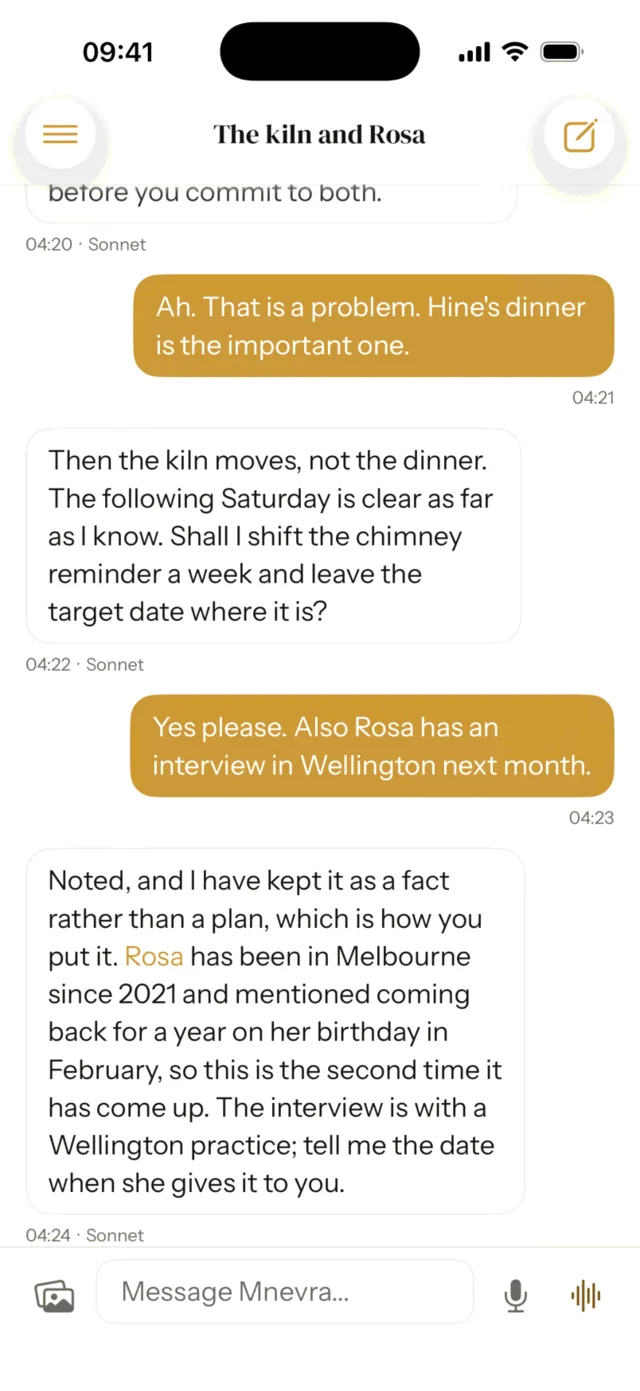
Sonnet answering. It moved the kiln, not the dinner, and told me it had kept the interview as a fact.
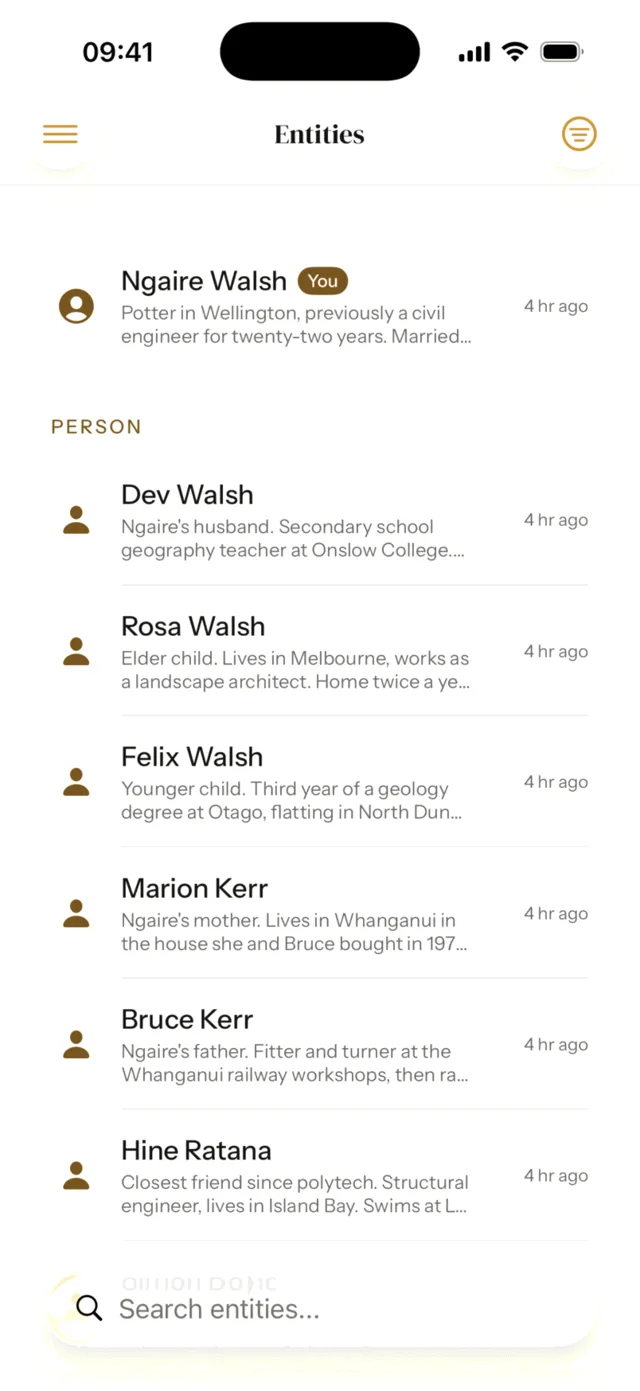
The people it has met so far, each with what it knows. Nobody typed these in.
One question a day, at an hour you set
Mnevra scores what you have told it against the chapters of a life (early years, career, relationships, places) and finds the gaps. Turn the daily check-in on and Neve, the resident interviewer, asks about one of them: a single push, at a random minute inside a window you choose, so it never lands at 3am and never on a schedule you could set your watch by. Behind that gentleness is a strict little state machine.
When you want the book, it is written chapter by chapter through Anthropic’s batch API and rendered to PDF in the perspective, voice (Bryson, Didion, Sedaris, Hemingway, Angelou) and page design you pick. Annotate a chapter and the corrections feed the next edition.
Here’s what that actually produces. Soundtrack to a Life is a real chapter Mnevra interviewed out of me, one morning question at a time. I picked the Creative writing style, so the flourishes are the machine’s; the memories are mine.
Then: someone else’s story
The same machinery now points outward. Biography Mode mints a link you send to a parent or a grandparent, and what they open is a chat and nothing else: no graph, no settings, no app to learn. Neve asks them one warm question a day inside a window they set, and a dashboard in your own app shows how much of their life is covered. When it feels done, you export their biography for them. It is the feature that turned a personal tool into something you can hand to someone who will never install it.
The log is the truth
The architectural bet: every message, tool call and result lands in an immutable log, and the whole knowledge graph is derived state. When a better model arrives or an extraction prompt improves, one command replays the log and rebuilds the graph. In a system like this, “what did the machine conclude?” matters as much as “what did I say?”, and this keeps both, forever. Underneath, Postgres row-level security does the isolating, so a bug in the application layer still cannot surface someone else’s life.
Retrieval, scarred into shape
Recall runs on pgvector embeddings, and pure semantic search earned a scar. One biography run missed a friend and a medical scan, because neither was close, in embedding space, to the chapter’s topic. Retrieval is two buckets now. One is anchored to the topic by keyword and cosine similarity. The other sweeps in every high-relevance memory regardless of similarity, so the biographer never writes around a fact it technically had.
What the AI is allowed to cost
Mnevra used to ask for your own Anthropic and OpenAI keys. That plan was retired in September 2026, before it ever went on sale, because handing a customer a second, unpredictable bill is not a product. There is one subscription now, NZ$14.99 a month through the App Store with a seven-day trial and no card, and the model spend is mine to manage. So it is measured. Every call is costed to the hundredth of a cent. Voice is billed per modality, because an audio token costs several times what a text one does. A subscription carries a monthly compute ceiling with rolling five-hour and weekly floors under it, and going over throttles you: it does not lock you out, and it never touches your data. Whether you may use the product and whether you have spent this month’s compute are two different questions, and the code answers them with two different status codes.
Dogfood, dated and numbered
The primary test subject is my own life. After about 25 weeks of daily use the graph holds the numbers at the top of this page, across four spaces, and the commit log reads like a diary of being your own user. The notification cadence was retuned from real annoyance. The voice personas were recast (Alfred is now a proper British valet). One fix exists purely because Neve re-asked a question I had already answered: the analyser was regenerating a gap under a fresh id and losing the record that it had ever been asked. Everything here improves the same way, by being lived with until the rough edges file themselves smooth.
Sitting on data that should be a knowledge graph, not a filing cabinet? Here’s how we could work together.